"Between stimulus and response there is a space. In that space is our power to choose our response."
Viktor Frankl
Beyond Primal Thinking
The key question is not the one we almost always think of first, "Why would someone believe something so irrational?" To move forward, we need to ask, "What experiences, motivations, or assumptions make that conclusion feel reasonable to them?"
We like to think that we see the world as it is.
We believe our opinions are based on evidence, our judgments are objective, and our decisions are rational. When someone disagrees with us, it's easy to assume they simply don't have all the facts.
Modern neuroscience and psychology paint a different picture.
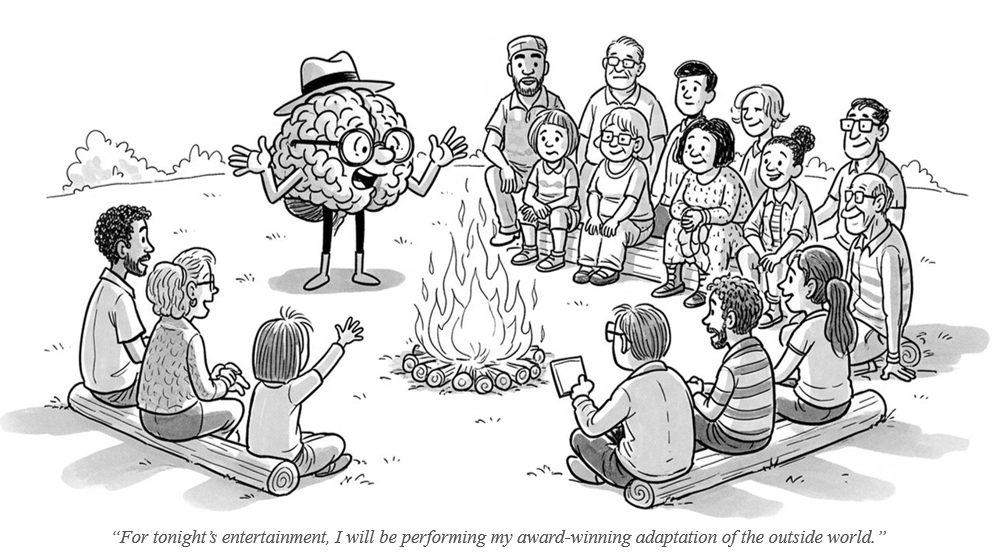
Our brains are extraordinary prediction machines. They are constantly interpreting the world, filling in missing information, and constructing a version of reality that helps us survive. That version often feels like objective truth, but it is deeply influenced by our experiences, emotions, identities, relationships, and motivations.
In other words, we don't simply experience reality.
We experience our brain's interpretation of reality. And the picture of reality it paints fulfills a fundamental need, especially when we are feeling anxious, fearful, and insecure and that is:
We would rather feel right than be right
We Are Products of Our Environment
Every experience leaves its mark.
Our families, cultures, education, friendships, successes, failures, communities, and life experiences shape the mental models we use to understand the world. Over time, these experiences become the lens through which we interpret new information.
That lens is so familiar that we rarely notice it.
Two people can witness the same event and walk away with completely different conclusions—not because one is lying or unintelligent, but because each person's brain is filtering the experience through a lifetime of different assumptions and expectations.
Our perceptions are not passive recordings of reality.
They are active constructions.
No man is an island,
Entire of itself.
Each is a piece of the continent,
A part of the main.
If a clod be washed away by the sea,
Europe is the less.
As well as if a promontory were.
As well as if a manor of thine own
Or of thine friend's were.
Each man's death diminishes me,
For I am involved in mankind.
Therefore, send not to know
For whom the bell tolls,
It tolls for thee.
John Donne
Truth Is Not Our Brain’s First Priority
It's tempting to think the brain evolved to understand reality as accurately as possible.
It didn't.
It evolved to keep us alive.
For our ancient ancestors, survival depended on quickly answering questions like:
Is this person friend or foe?
Do I belong here?
Am I respected?
Can I trust them?
Am I losing control?
Is my status threatened?
These questions had immediate consequences for survival and reproduction.
As a result, our brains became exceptionally good at protecting us from perceived threats—even social and psychological ones.
Today, our physical survival is rarely at stake, but our brains still respond powerfully to threats against our identity, our relationships, our beliefs, and our sense of belonging.
How Does Our Thinking Change When We Feel Threatened?
Psychologist Daniel Kahneman described two ways our brains process information.
System 1: Fast Thinking
System 1 is automatic.
It recognizes patterns, predicts outcomes, fills in gaps, and generates immediate emotional reactions long before we're consciously aware of them.
Without System 1 we couldn't drive a familiar route, recognize a friend's face, or react quickly to danger.
But speed comes with a cost.
System 1 favors what is familiar over what is accurate, certainty over ambiguity, and coherence over complexity. It creates stories that make sense, even when important pieces of information are missing.
System 1 is where cognitive distortions emerge.
Our brains selectively notice evidence that supports what we already believe.
We assume we know other people's intentions.
We overgeneralize from limited experiences.
We remember information that confirms our existing worldview while dismissing contradictory evidence.
These aren't character flaws.
They're efficient mental shortcuts that help maintain a coherent understanding of ourselves and our world.
The stronger the perceived threat to one of our BUCKET needs, the more likely System 1 is to defend our existing story.
Often without our awareness.
System 1 thinking is the type of thinking we automatically engage in when we feel anxious or threatened. We rely more on the inaccurate stories we tell ourselves than objective truth. In other words, we would rather feel right than be right.

System 2: Slow Thinking
System 2 is slower and more deliberate.
It steps back from our immediate reactions and asks us to look again.
It questions assumptions, evaluates evidence, considers alternatives, and notices inconsistencies. It allows us to ask whether our first impressions are accurate, whether important information might be missing, and whether there are other ways to interpret what is happening.
System 2 is what helps us tolerate ambiguity instead of rushing toward certainty.
It allows us to separate what we know from what we assume.
We can examine why we reached a particular conclusion, consider someone else's perspective, test our interpretations, and revise our thinking when new information emerges.
System 2 is where reflection becomes possible.
But this kind of thinking requires attention and effort.
Because our brains are designed to conserve energy, we naturally use System 2 sparingly. Most of the time, we rely on the speed and efficiency of System 1, even in situations where slowing down might lead to a more accurate or constructive response.
And when one of our BUCKET needs feels threatened, engaging System 2 can become even more difficult. The stronger the emotional reaction, the more convincing our initial System 1 story can feel.
The goal isn't to silence System 1.
We couldn't function without it.
The goal is to create enough space to notice when System 1 is shaping our thoughts, interpretations, and behaviors—and to recognize the moments when it may be worth slowing down, getting curious, and thinking again.
How Do We End Up in System 1 Precisely When We Need System 2?
In other words, what shapes the stories we tell ourselves? We’ve discussed the B.U.C.(k).E.T model and Identity.
BUCKET Model:
Belonging – feeling accepted and connected
Understanding – making sense of the world
Control – having influence and predictability
Enhancing Self – feeling competent, valued, and respected
Trust – believing others and our environment are safe and reliable
When one or more of these needs feels threatened, our brains don't simply process information differently—they begin protecting the threatened part of our identity.
The result is that our brains become less concerned with what is objectively true and more concerned about creating a story that restores psychological safety.
Identity
Our identities are more than labels. They are the stories we tell ourselves about who we are and where we belong. When information challenges those stories often through BUCkET domains, the brain often experiences it as a threat rather than an opportunity to learn. This helps explain why intelligent people can examine the same evidence and reach dramatically different conclusions.
The disagreement usually isn't about intelligence.
It's about identity.
Different identities produce different interpretations of the same reality.
Different identities will pay attention to and value different sources of information. Not because those sources are actually more accurate, but because the information they present supports what we want to believe.
The Result? Motivated Reasoning
Despite thinking we follow the evidence wherever it leads, when are identities and BUCkET domains are contriving to make us feel threatened, we become more likely to use evidence to defend conclusions our brains have already reached.
This is known as motivated reasoning—our tendency to interpret information in ways that protect our existing beliefs, identities, and psychological needs. Rather than asking, "What's true?" our brains often ask, "What allows me to keep believing what feels safe, familiar, or important?"
When our sense of belonging, understanding, control, self-worth, or trust is threatened, System 1 quickly begins searching for reasons to dismiss, reinterpret, or challenge information that creates discomfort. System 2 is then often recruited not to discover the truth, but to justify the conclusion we've already reached.
When we wonder why a smart, well-educated person could hold certain beliefs this is what is going on. Studies show that the more well-educated or adept a person is, the more convincing the story they can craft to justify their way of thinking. This is why education cannot be the only solution.
Motivated reasoning isn't a flaw unique to certain people—it is a universal feature of the human mind. Recognizing it in ourselves is one of the first steps toward genuine curiosity, more productive dialogue, and wiser decisions.
Neuroplasticity and Environmental Factors
Our brains are constantly changing in response to our experiences, thoughts, and behaviors—a remarkable ability known as neuroplasticity. Like a path in the forest the patterns we repeat become stronger and more automatic over time, helping us learn and adapt but also reinforcing the assumptions, biases, and cognitive distortions that shape how we see the world. Understanding neuroplasticity helps us recognize that while our thinking is influenced by the past, it is never permanently fixed.

-
Our brains are not static. Over time, neuronal connections in the brain can change because our brains have plasticity. It’s a bit of an oversimplification, but at the heart of neuroplasticity is Hebbs’ Rule. Hebb’s Rule essentially states “nerves that fire together wire together”. Adjacent nerves that fire in a given repeated sequence over time will form stronger connections. The result of this is that many of our thoughts become habituated, i.e., automatic. This is often a good thing because it saves energy and time. It is why with a lot of practice athletes can make things look effortless. At the same time, this process is responsible for the cognitive distortions that cause us a great deal of trouble.
Plasticity is self-reinforcing in that frequently used mental pathways cause us to attend to information that bolsters those pathways while ignoring information that does not. Conversely, the neural pathways related to the information that gets ignored, get weaker.
Can you see how these days, news and social media reinforce how our brains are wired? They offer strongly confirmatory information while also making contrary information seem scarier than it is. Our thoughts, much like choosing a path to go down, will most often, unless we are fans of Robert Frost, chose the circuit more traveled by. With an estimated 95% of our brain activity taking place automatically and out of our conscious awareness we are strongly susceptible to manipulation because we do not know when it is happening.
Where the Hope Is
Meta-cognition: Conscious evolution beyond primal thinking
Despite our primal wiring, we are not doomed to remain trapped by it.
What makes human beings extraordinary is our capacity for meta-cognition—the ability to think about how we think. We can observe our own mental processes, bringing unconscious patterns, emotional triggers, and inherited narratives into conscious awareness.
We can notice our emotional reactions before acting on them. We can question the stories our minds automatically create. We can become curious instead of defensive.
Or we can ask ourselves:
"What else might be true?"
That moment of reflection is System 2 coming online.
It doesn't eliminate bias or cognitive distortions, but it creates space between our automatic reactions and our deliberate choices.
That awareness changes everything.
As we become more conscious of the forces shaping us—culture, identity, fear, and tribal belonging—we become less captive to them. We begin to recognize the invisible channels that narrow our perspectives and pull us toward reactive, divisive ways of engaging with the world.
This awareness gives us agency.
And because the brain is adaptable, awareness is only the beginning. Through neuroplasticity, we can literally rewire our brains. With intention and practice, we can cultivate new habits of perception, thought, and connection.
This is our greatest hope: human evolution is not over.
A more empathic, less tribal future is not wishful thinking—it is biologically possible. We have the capacity to consciously evolve beyond reflexive division toward greater empathy, deeper understanding, and wiser collective action.
At Beyond Primal, we believe conscious evolution is the next frontier. By becoming aware of our conditioning and intentionally reshaping it, we can help build a society defined less by reactivity and polarization—and more by empathy, wisdom, and human flourishing.
Turning Hope into Reality: Brain-based Holistic Dialogue as the Way Forward
Brain-Based Holistic Dialogue brings both types of thinking together in a structured, reflective space where we think together about how we are thinking so that we can begin to think in new ways with compassion and grace.
Brain-based Holistic Dialogue begins with a simple assumption:
Most people are not intentionally irrational.
They are making sense of the world using a brain shaped by evolution, experience, identity, and universal human needs.
When we understand how perception is constructed, we become less interested in proving ourselves right and more interested in understanding how different people arrived at different conclusions.
That shift—from certainty to curiosity—is where genuine dialogue begins.
It is also where personal growth, stronger relationships, healthier organizations, and more compassionate communities become possible.