
“The collective thought is more powerful than the individual thought.”
— David Bohm
“Everything that irritates us about others can lead us to an understanding of ourselves.”
— Carl Jung
The Brain-based Holistic Dialogue Framework
Empowering the Empathic Stance
The Brain-based Holistic Dialogue Framework: A Shared Human Starting Point
What drives us, what we seek to protect and nurture, how we make sense of the world, and how we engage with others can either keep us stuck in our differences or open the door to something new.
Brain-based Holistic Dialogue is built on a simple premise: before we can engage effectively with others, we must better understand the primal forces shaping ourselves.
We often enter difficult conversations convinced that the problem is the other person's unwillingness to listen or understand.
But what if the first obstacle to meaningful dialogue is something happening inside ourselves?
Brain-Based Holistic Dialogue begins with that question. By exploring the instincts, identities, experiences, and communication patterns that shape our reactions, we create opportunities to engage one another with greater curiosity, empathy, and understanding.
We call it holistic because meaningful dialogue involves more than the words we exchange. It requires understanding the many forces at work within us and between us that shape how we think, feel, and respond to one another.
Why is Brain-based Holistic Dialogue Necessary?
Dialogue, as we normally think of it, offers a powerful path to mutual understanding and the discovery of new possibilities. Yet in today’s most consequential conversations, people often react before they reflect. Beneath every disagreement, ancient neural systems are constantly scanning for threat, belonging, status, and safety. When leaders, media, and social platforms repeatedly activate these systems, differences can begin to feel less like disagreements and more like dangers.
The challenge is not simply personal—it is systemic. Every conversation unfolds within a dynamic interaction of brain, identity, culture, and social influence. These forces shape not only what we think, but how we interpret others and respond in real time. Under conditions of perceived threat, curiosity narrows, empathy weakens, and even well-facilitated dialogue can struggle to create the safety needed for genuine understanding.
This is why the Empathic Stance is essential. By approaching ourselves and others with curiosity before judgment, we learn to recognize our instinctive reactions and the shared human needs beneath our differences. Brain-Based Holistic Dialogue builds on this awareness by exploring the biological, psychological, social, and systemic forces shaping our interactions. It won't resolve every disagreement or bridge every divide. Its power lies in creating an opening—a chance to move beyond defensiveness, understand one another more deeply, and discover possibilities that might otherwise remain out of reach.
The Brain-based Holistic Dialogue Framework
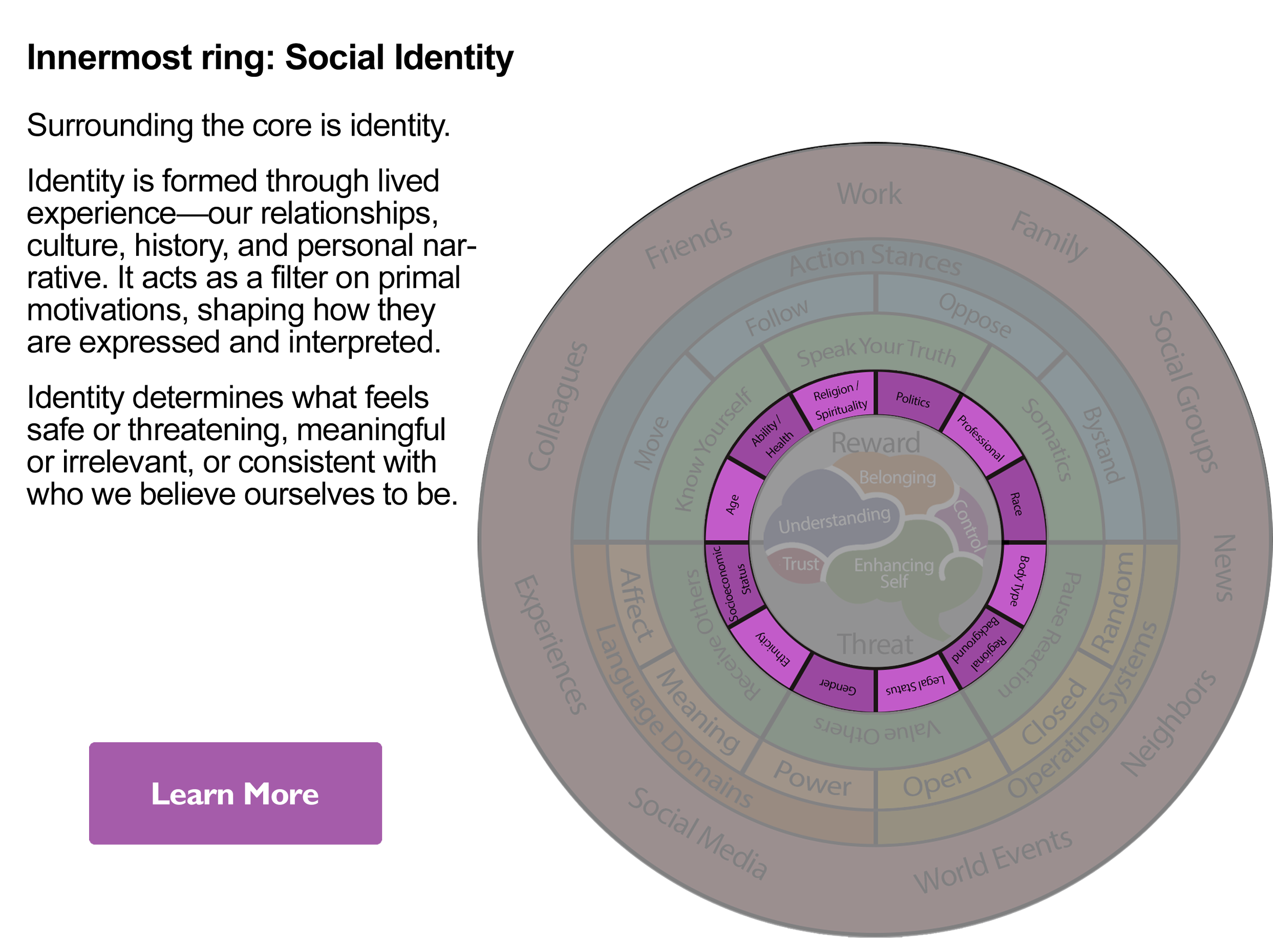
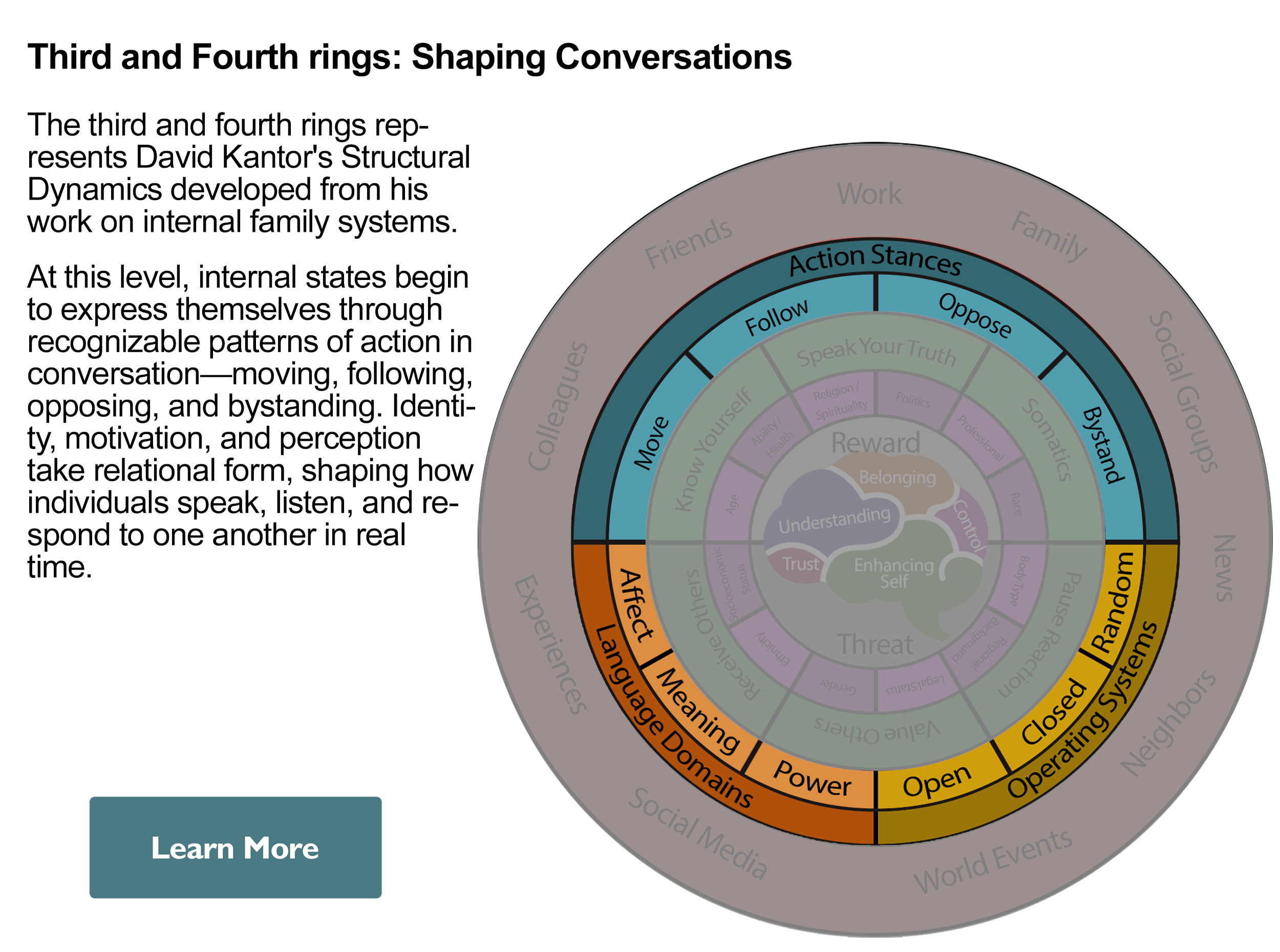
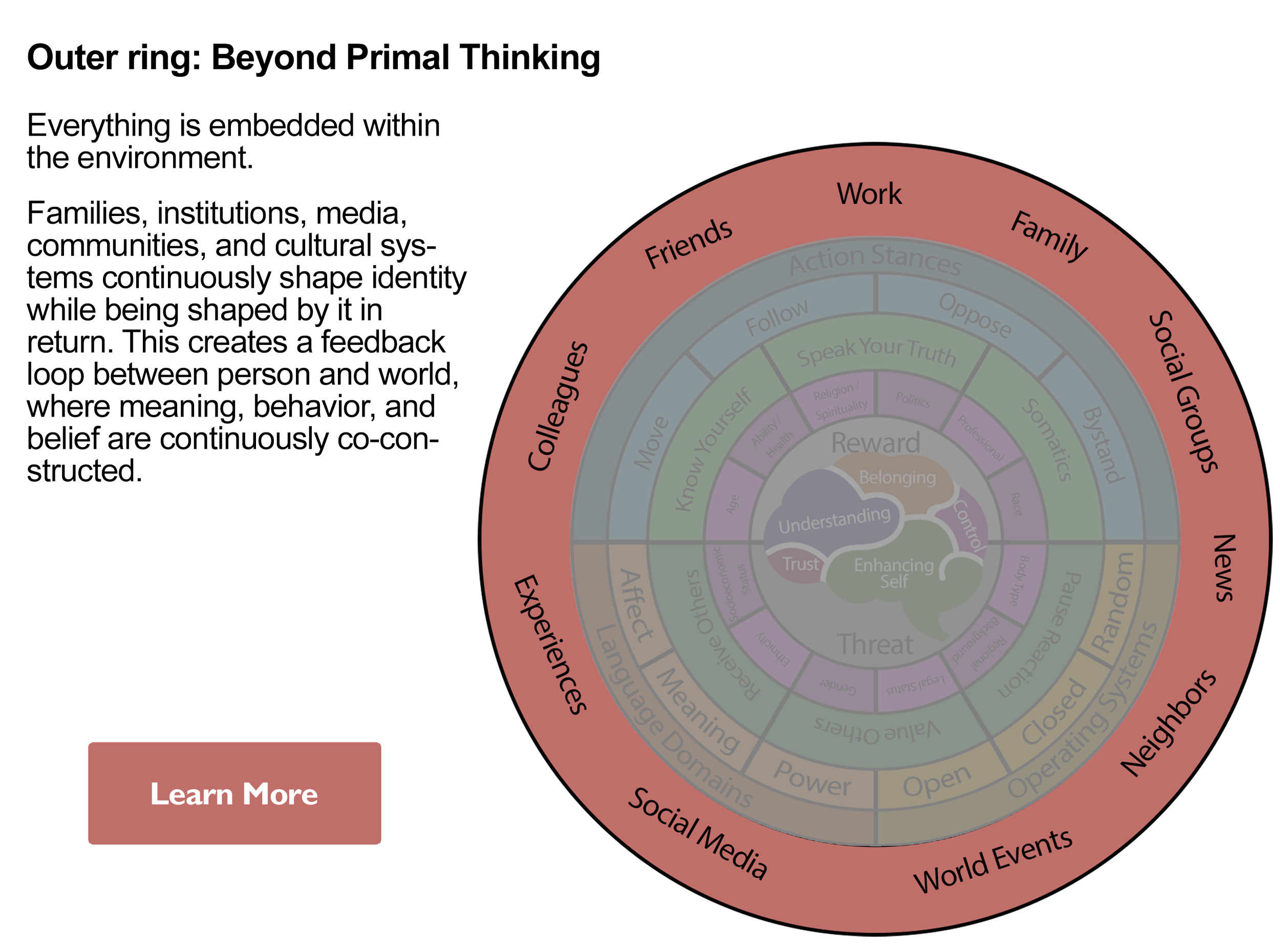
Using the brain-based holistic dialogue framework, we help participants surface, integrate, and bring their whole selves to productive, generative dialogue. The mandala below visualizes the relationship between the different elements of the framework.
Click the Learn More button to learn about each element in more detail.



The Framework in Action:
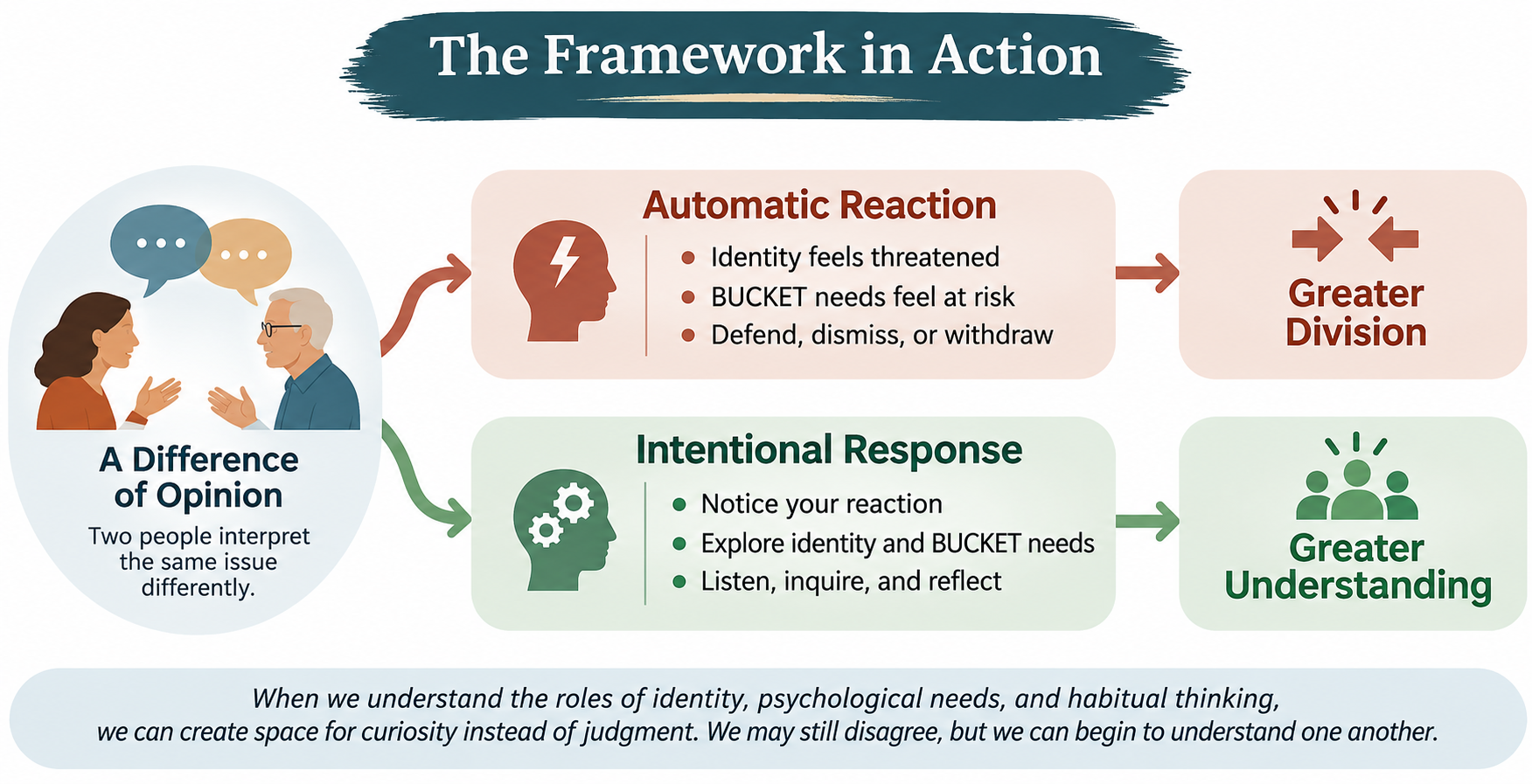
Immigration Example
Same Human Wiring, Different Perspectives
Few issues divide people as deeply as immigration. Some believe stronger border security and enforcement are essential to protecting jobs, public safety, and the rule of law. Others see current enforcement practices as threatening families, human dignity, and opportunities for a better life.
Both may be convinced their position is reasonable and the other's is not.
How can people reach such different conclusions, each believing they're right?
The Beyond Primal framework helps us explore how the same fundamental human processes can lead to very different perspectives.
Primal Motivation and Social Identity: Same Needs, Different Threats
Consider how our needs for Control, Belonging, and Trust might be experienced through different identity lenses.
Someone who identifies strongly with protecting their community might experience:
Control: Concern about maintaining public safety and economic stability.
Belonging: Concern about preserving the character and traditions of their community.
Trust: Concern about whether government is enforcing immigration laws effectively.
Someone who identifies closely with immigrant families might experience:
Control: Concern about protecting their family's security and future.
Belonging: Concern about remaining accepted in the community they call home.
Trust: Concern about whether government will enforce immigration laws fairly and humanely.
The needs are the same. Our identities and experiences shape what threatens them—and what we believe must be done to protect them.
Our need to belong can also make reconsidering our positions difficult. Even acknowledging a legitimate concern raised by the other side might feel like betraying our own group.
Beyond Primal Thinking: Why Does Our Position Feel So Obvious?
Our motivations, identities, and experiences influence which information we seek, which sources we trust, and what we notice or disregard.
Someone concerned about security may find reports of crime or failures in border enforcement particularly compelling. Someone concerned about immigrant welfare may focus on stories of family separation and mistreatment.
Both may encounter legitimate evidence while overlooking information that complicates their understanding. We tend to trust information reinforcing our beliefs and more readily dismiss what challenges them.
We don't just defend our beliefs. We may unconsciously filter the world in ways that reinforce them.
Did you get irritated at the very thought of being reasonable?
Did you find yourself agreeing with one perspective and becoming irritated by the other? Maybe you're already thinking about why one of these descriptions is unfair or misleading.
That's an opportunity to put the framework to work.
What feels threatened? What are you trying to protect or nurture? How are your identities and experiences shaping your interpretation? What information might you be overlooking? Would people in your own group disapprove if you acknowledged something reasonable about the other side?
Now imagine extending that same curiosity to someone whose position you find difficult to understand.
Finding a Way Forward: Starting with What We Share
Recognizing shared motivations doesn't mean ignoring our differences. It gives us a different place to begin the conversation.
Instead of immediately debating immigration policies, imagine two people acknowledging what matters to them.
One might say, "I want to know our laws are being enforced and our communities are safe."
The other might respond, "I want families to feel secure and know they'll be treated fairly."
Neither has abandoned their convictions. But both have expressed concerns rooted in shared fundamental human needs.
What if they began exploring how those needs might be addressed together?
Control: How can we provide greater security and stability for communities and immigrant families?
Belonging: How can we preserve what people value about their communities while respecting the dignity of those seeking to become part of them?
Trust: What would effective, fair, and accountable immigration enforcement look like?
Their answers may still differ considerably. But these questions create opportunities to explore one another's concerns, examine evidence, and consider solutions that might otherwise be dismissed.
The goal isn't to erase our different identities. It's to recognize the shared human needs beneath them and explore possibilities that respect both.
Creating an Opening
We cannot know precisely why someone believes what they do without understanding their experiences. Nor does understanding require agreement, excuse harmful behavior, or make every conclusion equally valid.
But recognizing that the same fundamental human processes shaping their perspective are also shaping ours gives us a reason to approach others with curiosity before judgment.
That's the power of the Empathic Stance. It helps us resist automatic defensiveness, question our assumptions, and better understand others—even when we strongly disagree.
Brain-Based Holistic Dialogue won't resolve every disagreement. Its power lies in creating an opening where something new becomes possible.